Why Does Chinese Taipei Compete Instead of Taiwan at the LLWS?
Every August in Williamsport, the scoreboard lists a team called Chinese Taipei. The fans wave a flag with a red, blue, and white sunburst. The players wear jerseys that say Chinese Taipei. Almost every American watching asks the same question. Why is it not just called Taiwan?
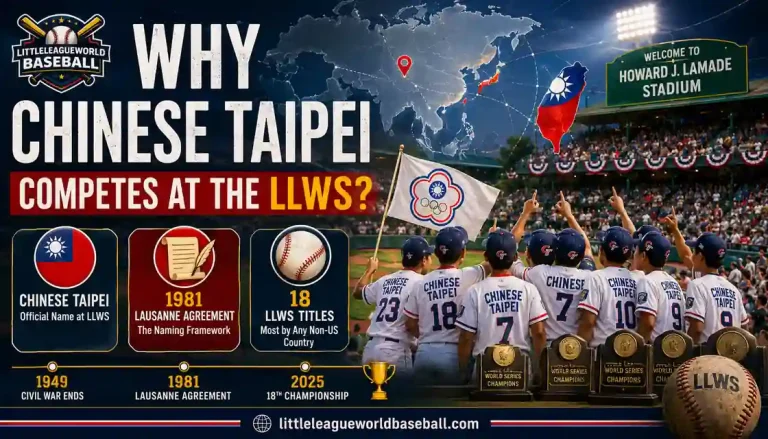
| Official Name at LLWS | Chinese Taipei |
| Actual Location | Taiwan (Republic of China) |
| Name Origin | 1981 Lausanne Agreement with IOC |
| First LLWS Appearance | 1969 as Chinese Taipei |
| LLWS Championships | 18, most of any non-US country |
| Last Championship | 2025, beat Nevada 7-0 |
| Flag at LLWS | Republic of China flag permitted, rare exception |
| Why Not Taiwan | One China policy, PRC pressure on international bodies |
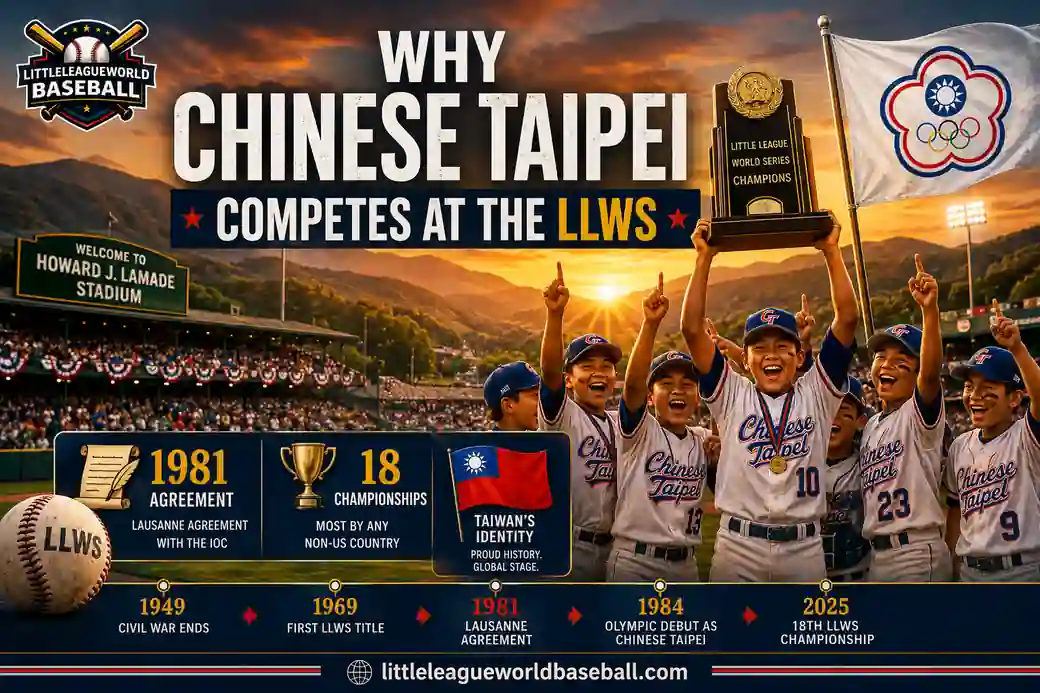
The answer involves a civil war, a 1981 agreement in Switzerland, and 18 Little League World Series championships. It is one of the most politically layered naming situations in all of sports. This guide explains all of it, from the beginning.
Why Chinese Taipei and Not Taiwan
Taiwan’s official government name is the Republic of China. The People’s Republic of China claims Taiwan as its territory. It pressures international bodies not to recognize Taiwan as separate.
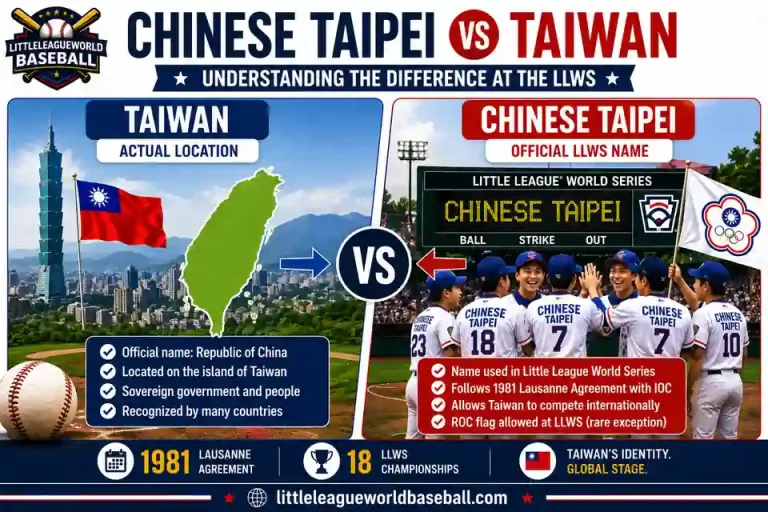
In 1981, Taiwan and the IOC reached a compromise. Taiwan could keep competing as Chinese Taipei. Little League follows that same framework.
The Williamsport exception: The LLWS is one of the only international sporting events where the Republic of China flag, Taiwan’s actual national flag, is permitted to be waved by fans in the stands. At the Olympics, that flag is banned. At the LLWS, Taiwanese fans have waved their national flag openly for decades. Williamsport became a symbol of national pride for Taiwan precisely because it was one of the last places where that flag was allowed.
The Complete History Behind the Chinese Taipei Name
Two Chinas, Chinese Civil War Ends
1949
The Chinese Civil War ends with the Communist Party under Mao Zedong controlling mainland China as the People’s Republic of China. The Nationalist government of Chiang Kai-shek retreated to the island of Taiwan and continues to call itself the Republic of China. Both governments claim to be the legitimate rulers of all of China.
First LLWS Appearance as Chinese Taipei
1969
Taiwan competes in the LLWS for the first time under the name Chinese Taipei. They won the championship immediately, beating Santa Clara, California. The Taiwanese government views the victory as an international propaganda win at a time when the country faces growing diplomatic isolation.
Taiwan Expelled from the United Nations
1971
The United Nations votes to recognize the People’s Republic of China as the only legitimate Chinese government. Taiwan loses its UN seat. Its international isolation accelerates. Sports have become one of the few stages left where Taiwan can project national identity to the world.
Nixon Visits China
1972
US President Richard Nixon visits Beijing and begins the process of normalizing US-China relations. This further weakens Taiwan’s diplomatic position and increases pressure on Taiwan in international organizations.
Taiwan Wins Fourth Straight LLWS Title
1974
Taiwan wins its fourth consecutive LLWS championship. The team is booed at Lamade Stadium because many fans suspect them of cheating, selecting players from across the entire country rather than a single local community, which is what Little League rules require. Later investigations confirmed these suspicions.
All International Teams Banned from LLWS
1975
Little League bans all non-US teams from the tournament on November 11, 1974, citing travel costs and nationalism. The real reason included suspicions of age fraud and roster violations. The ban lasts one year; international teams return for the 1976 LLWS.
Taiwan Boycotts Montreal Olympics
1976
Canada refused to allow Taiwan to compete as the Republic of China at the 1976 Montreal Olympics. The IOC votes to change the name to Taiwan. The ROC government rejects that name and boycotts the games entirely. The same scenario repeats at the 1980 Moscow Olympics.
US Recognizes People’s Republic of China
1979
The United States officially switches diplomatic recognition from Taiwan to the People’s Republic of China. Taiwan’s international isolation is now complete. Under the One China policy, the US refers to Taiwan as Chinese Taipei in official contexts. This framework eventually flows into how Little League International handles the name.
The Lausanne Agreement
1981
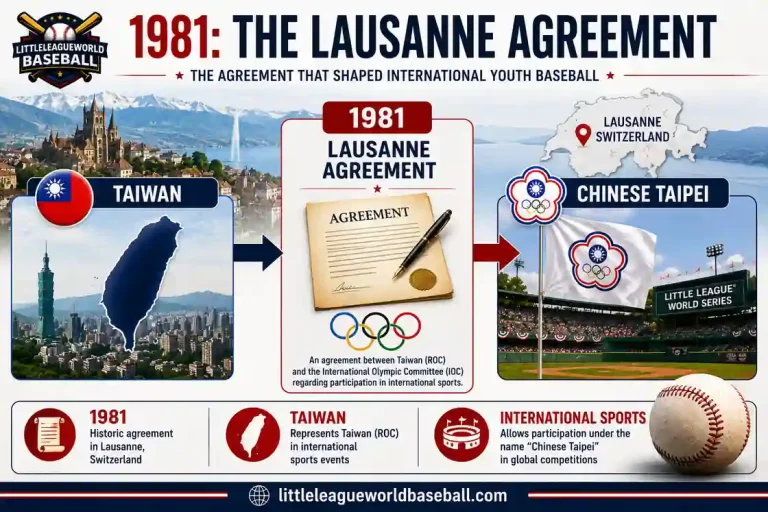
Taiwan and the International Olympic Committee signed the Lausanne Agreement in March 1981. Taiwan agrees to compete as Chinese Taipei using a special flag, the Plum Blossom Banner, and a special anthem instead of the ROC national flag and anthem. In exchange, Taiwan keeps its seat in all IOC-affiliated sports. This framework becomes the model for how Taiwan participates in international sports permanently.
Chinese Taipei Debuts at Olympics Under New Name
1984
Taiwan competed at the 1984 Los Angeles Olympics as Chinese Taipei for the first time. The template set at the Olympics flows through every major international sports body, including Little League International, from this point forward.
Chinese Taipei Wins 18th LLWS Title
2025
Tung-Yuan Little League from Taoyuan City beats Nevada 7-0. Lin Chin-Tse takes a perfect game into the fifth inning. Chinese Taipei wins its 18th LLWS championship, the most of any non-US country. The name Chinese Taipei appears on the Lamade Stadium scoreboard one more time.
The One China Policy and Why It Affects Little League
The People’s Republic of China has one non-negotiable condition. Any country or organization that wants to work with it must accept that there is only one China. Taiwan is not a separate country under this view. It is a province that has not yet been reunified.
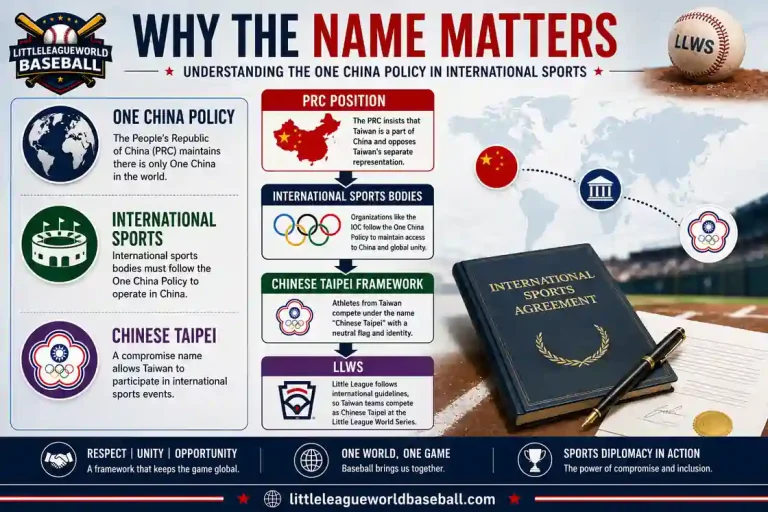
This condition extends to international sports bodies. The IOC accepted it in 1971 when it recognized the PRC and pushed Taiwan out. The solution in 1981 was the Chinese Taipei compromise. Taiwan could stay in sports as long as it did not call itself Taiwan.
Little League International follows the IOC framework. When it lists a team as Chinese Taipei, it follows the same convention used by the Olympics.
| Organization | Name Used for Taiwan | Flag Permitted |
|---|---|---|
| Little League International | Chinese Taipei | ROC flag permitted at LLWS, rare exception |
| International Olympic Committee | Chinese Taipei | ROC flag banned , Plum Blossom Banner required |
| World Baseball Classic | Chinese Taipei | ROC flag banned at official venues |
| FIFA World Cup | Chinese Taipei | ROC flag banned |
| Associated Press | Taiwan | N/A, press organization |
| Fox News | Taiwan | N/A press organization |
| ESPN | Chinese Taipei | N/A |
| United States Government | Chinese Taipei (official), Taiwan (informal) | ROC flag not flown at US government buildings |
This is not a decision Little League made on its own. It is a global framework. Little League participates in it as a member of the international sports community.
The media split in 2025: When Chinese Taipei won the 2025 LLWS championship, major sports outlets split on the name. ESPN, The Athletic, and most national outlets used Chinese Taipei. The Associated Press and Fox News used Taiwan. Both are technically defensible. Chinese Taipei is the official Little League name. Taiwan is what the country calls itself and what most Americans know it as informally.
Chinese Taipei at the LLWS: The Record Books
Whatever you call them, the teams from Taiwan have dominated the LLWS more than any other country except the United States. Eighteen championships in 56 years of competition. Five consecutive titles twice. Only two other countries have won more than three championships in the tournament’s history.
LLWS
18
Championships
First LLWS
1969
Title
Most Recent
2025
Title
Consecutive titles
5
twice
| Period | Championships Won | Context |
|---|---|---|
| 1969 to 1974 | 5 in 6 years | Taiwan’s first dominant era. Won in 1969, 1971, 1972, 1973, and 1974. Booed at Williamsport in 1974. Banned in 1975. |
| 1977 to 1981 | 5 consecutive | Returned after the 1975 ban and won five straight. Longest winning streak in LLWS history. |
| 1986 to 1996 | Multiple titles | Continued dominance through the late 80s and 90s. The last championship before the 29-year drought was in 1996. |
| 1997 to 2024 | 0 | 29-year drought. US teams dominated. Chinese Taipei reached the final in 2009 and 2024 but did not win. |
| 2025 | 1, 18th total | Tung-Yuan LL beats Nevada 7-0. Lin Chin-Tse is dominant. Ends the longest title drought in Chinese Taipei LLWS history. |
Why Fans Can Wave the ROC Flag at Williamsport
At the Olympics, Taiwanese athletes compete under the Plum Blossom Banner, a white flag with the Olympic rings and a special emblem. They do not use the Republic of China national flag. That flag is banned at Olympic venues under the IOC agreement.
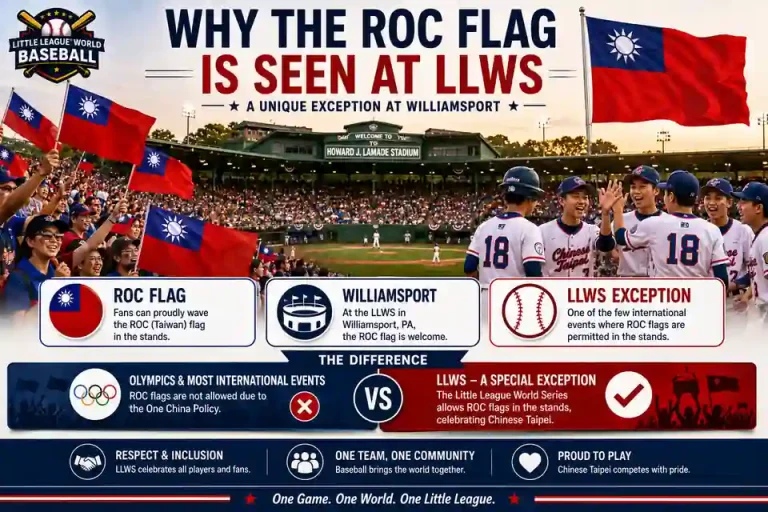
At the LLWS, the rules are different. Little League International permits fans to bring and wave the ROC flag in the stands. This has made Williamsport one of the only international sporting events in the world where the Republic of China flag is openly displayed by hundreds of fans.
For Taiwanese Americans, this matters enormously. In the 1970s and 1980s, Taiwan faced deep international isolation. Hundreds of expats came to Williamsport just to wave that flag. Williamsport was not just a baseball tournament. It was one of the only stages where their national identity was visible.
The Plum Blossom Banner: At official Little League events, Chinese Taipei competes under the Plum Blossom Banner, a white flag with a blue Olympic-style ring design. But in the stands, Taiwanese fans bring and wave the full red, blue, and white Republic of China national flag. Little League does not prohibit this. It remains one of the most visible differences between how the LLWS handles the Taiwan name issue versus how the Olympics handles it.
Should It Be Called Taiwan Instead of Chinese Taipei?
This is a genuinely contested question. There are reasonable arguments on both sides.
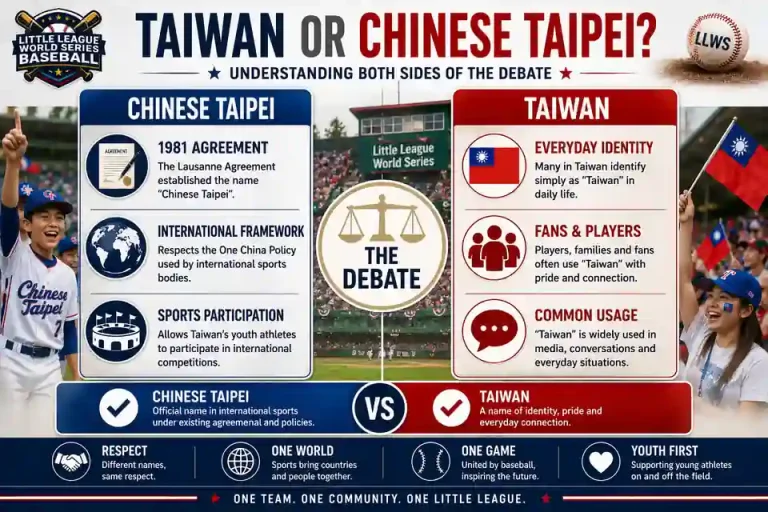
The Case for Chinese Taipei
Chinese Taipei is the name Taiwan agreed to in 1981. Taiwan’s own government signed the Lausanne Agreement. Without that deal, Taiwan might have been excluded from international sports entirely. The name also reflects political reality. Taiwan’s sovereignty is genuinely disputed. It is not universally recognized as independent.
The Case for Taiwan
The players are from Taiwan. The fans are from Taiwan. The country calls itself Taiwan in everyday life. Chinese Taipei was created under pressure from China. Many Taiwanese citizens find the label politically uncomfortable. The Associated Press and Fox News use Taiwan instead.
What Little League Does
Little League uses Chinese Taipei because it follows the IOC framework. That is unlikely to change unless the IOC changes first. The more meaningful distinction is permitting the ROC flag in the stands. The Olympics do not allow that. Little League gives Taiwan more visibility than most organizations do.
Conclusion
Chinese Taipei competes at the LLWS because of a 1981 agreement. That deal let Taiwan stay in international sports under a compromise name. China’s One China policy drove it.
Little League follows the same IOC framework. The players are from Taiwan. They compete as Chinese Taipei. Their fans wave the ROC flag at Lamade Stadium.
That flag is openly permitted at Williamsport. It is one of the only places in the world where that is true. With 18 championships, they are the most successful non-US program in LLWS history.