
Most Emotional Moments in Little League World Series History
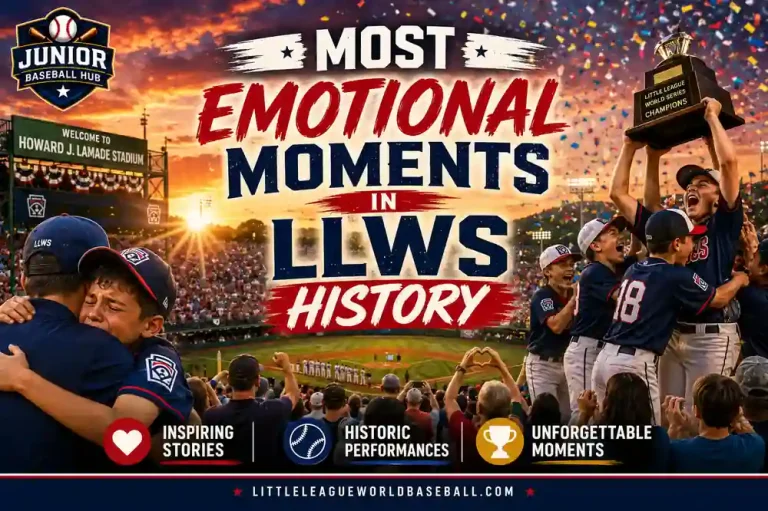
No tournament in youth sports produces emotion like the Little League World Series. Professional athletes perform for money and trophies. These 12-year-olds play for something harder to name. Pride. Family. A lifetime of practice on a field back home. Every hit matters. Every out hurts. Every moment is real.
| First Tournament | 1947 in Williamsport, Pennsylvania |
| 2026 Edition | 79th annual tournament, August 19 to 30 |
| Player Ages | 10 to 12 years old |
| Teams | 20 teams, 10 US, 10 international |
Since 1947, Williamsport has been the stage for moments that stopped people mid-conversation. Some happened on the mound. Some happened in the stands. Some happened in a hospital room 200 miles away. Here are the most emotional moments in LLWS history.
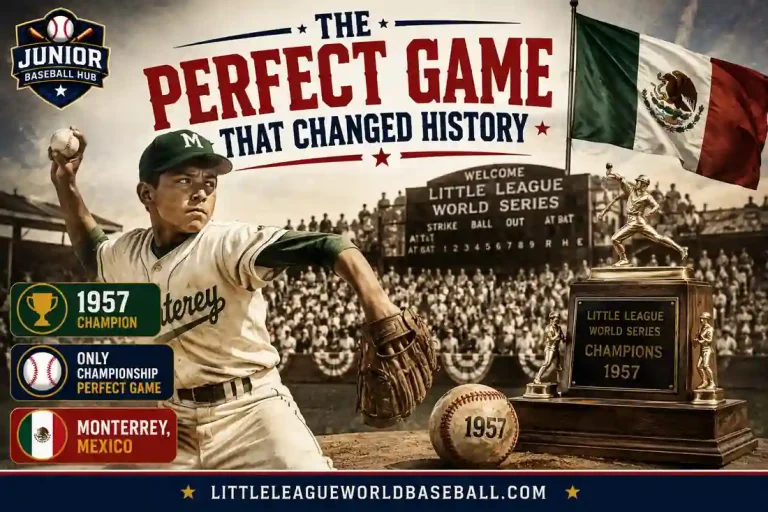
1957 – Angel Macias Throws the Perfect Game for Monterrey, Mexico
The boys from Monterrey, Mexico had no business being in Williamsport. They came from poverty. Most of them had only recently learned the game. Their equipment was second-hand. When they arrived at the 1957 Little League World Series, they were expected to lose early and go home. They did not lose. Not once. Not a single game.
In the championship game against La Mesa, California, their pitcher Angel Macias threw the first and only perfect game in LLWS championship history. He retired all 18 batters he faced. Macias was also ambidextrous and threw with both arms during the tournament. Monterrey won and became the first international team to claim the Little League World Series title.
The story is so extraordinary that it became a feature film in 2009 called “The Perfect Game.” It remains the most improbable and inspiring moment in the tournament’s 79-year history.
What made it emotional: A group of boys from Mexico who barely knew the game arrived in Pennsylvania with no expectations and left as world champions. Macias threw a perfect game in the biggest moment of his life at age 12. The entire town of Monterrey celebrated for days.
2014 – Mo’ne Davis Makes History at the Little League World Series
Mo’ne Davis was 13 years old. She threw 70 miles per hour. That is the equivalent of 93 mph reaction time on a full-sized diamond. She played for Taney Little League from Philadelphia and arrived in Williamsport as the only girl on her team.
On August 15, 2014, Davis became the first female pitcher in LLWS history to throw a shutout and earn a win. She struck out 8 batters and gave up only 2 hits in a complete-game performance. One of the batters she struck out that day was Robert Hassell III, on his birthday. Hassell was later drafted 8th overall in the 2020 MLB Draft and made his Major League debut in 2025.
Davis appeared on the cover of Sports Illustrated. She became the first Little League player ever to do so. The baseball world stopped for two weeks in August 2014 to watch a 13-year-old girl from Philadelphia throw gas past boys who outweighed her by 30 pounds.
The 2025 reunion: Eleven years after facing off in Williamsport, Davis and Hassell reunited at Nationals Park in Washington, DC. Davis threw out the ceremonial first pitch. Hassell caught it behind the plate. He was now an MLB outfielder. She was the same girl who had struck him out on his birthday in front of the whole world. “She was throwing gas,” Hassell said.
2016 – JT Garcia Hits a Home Run While His Mother Watches From the Stands
Jen Garcia had come to Williamsport between chemotherapy treatments. She was battling pancreatic cancer. She made the trip from Iowa because her son JT was playing in the Little League World Series and she was not going to miss it.
ESPN’s Jaymee Sire found Jen in the stands and began interviewing her. She asked how the team had rallied around her diagnosis. Mid-interview, JT Garcia stepped to the plate. He hit a home run to give Iowa a 4-1 lead over California. Sire had to stop the interview. The entire section around Jen was in tears.
It was a magical moment that had the entire section in tears, including me. This was definitely the most special of them all. It’s a moment I will never forget. “Jaymee Sire, ESPN broadcaster, on the JT Garcia moment, 2016“
Sire later said it was the third time she had interviewed a family member mid-home run, but nothing compared to this. The circumstances, the timing, the cancer diagnosis, the smile on Jen’s face- it was the kind of moment that reminds everyone why youth sports exist.
2016 – A Coach Walks to the Mound Just to Tell His Son He Loves Him
Joel Jensen was the head coach for his son Isaiah’s team at the 2016 Little League World Series. At some point in the game, he called a mound visit. He walked out to the pitcher’s mound, where his 12-year-old son was standing on the biggest stage of his young life.
He did not talk about pitch selection. He did not talk about the batter. He told Isaiah he loved him. Then he walked back to the dugout. Isaiah struck out the next batter he faced.
Why it resonated: Every parent watching that moment thought about their own kid on a mound, a court, or a field somewhere. Joel Jensen said everything a parent needs to say. He said it at exactly the right time. Isaiah responded the way every coach hopes their player will.
2017 – Omar Romero Leaves His Celebration to Comfort a Fallen Opponent
Venezuela and the Dominican Republic played one of the most dramatic games in recent LLWS history in 2017. The Dominican Republic’s Edward Uceta was the breakout star of the tournament. But on this night, his second pitch after a long rain delay was hit for a walk-off triple by Venezuela’s Omar Romero. Venezuela won 3-2.
Uceta collapsed face-down on the pitcher’s mound. He could not get up. His teammates gathered around him. The Venezuelan players were celebrating around the infield.
Then Romero walked away from his own celebration. He went to the mound and crouched down next to Uceta. He put his hand on his back. He stayed there. The entire stadium went silent. Then it erupted.
What it said about sports: Romero was 12 years old and had just hit the biggest hit of his life. His first instinct was not to celebrate. It was to check on the kid who was face-down on the ground. That is the kind of sportsmanship that coaches spend years trying to teach. Romero did it instinctively at age 12 in front of the whole world.
2019 – Bowling Green Hangs Mason Goodnight’s Jersey in the Dugout
Bowling Green Eastern Little League from Kentucky came to Williamsport in 2019 with 13 players on their roster and one extra jersey in their dugout. It belonged to Mason Goodnight, a former teammate who had passed away before the season.
Every game they played in Williamsport, Mason’s jersey hung in the dugout. They brought him to every game. They carried him through every inning. The tournament did not stop to announce it. The scoreboard did not display it. It was just there, in the dugout, every time the camera found it.
Why it stands out: Nobody organized this moment. Nobody planned it for television. A group of 12-year-old boys decided their teammate was coming to Williamsport with them. They made it happen quietly, without asking for attention. That is exactly why it became one of the most talked-about moments of the 2019 tournament.
2019 – Maddy Freking Takes the Mound and Does Not Flinch
Maddy Freking from Minnesota became the 19th girl to play in the Little League World Series in 2019. She was the first since Mo’ne Davis and Emma March in 2014. As a pitcher, she was also only the sixth girl in LLWS history to face opposing batters from the mound.
She recorded a strikeout and threw out a runner at home in the same game. The crowd at Volunteer Stadium cheered every pitch. ESPN analyst Jessica Mendoza noted what stood out most.
I loved the intensity in her eyes when she was on the mound but enjoyed even more how much being the only girl at the tournament did not faze her one bit. She was just another pitcher trying to help her team get a win.”Jessica Mendoza, ESPN analyst, on Maddy Freking, 2019“
2022 – Brogan Oliverson Gets a Standing Ovation in His First At-Bat
On August 15, 2022, Easton Oliverson of Snow Canyon Little League from Santa Clara, Utah, fell from a top bunk bed at the LLWS dormitory. He fractured his skull and suffered a brain hemorrhage. He was airlifted to Geisinger Janet Weis Children’s Hospital and underwent emergency surgery.
Four days later, his younger brother Brogan was added to the Snow Canyon roster as an eligible replacement. In Utah’s first game of the tournament against the Southeast Region, Brogan was called to pinch hit.
Every person in Volunteer Stadium stood up. The crowd gave him a standing ovation before he stepped into the batter’s box. He had not done anything yet. He was just Easton’s brother, standing in for the player who could not be there. That was enough.
Mookie Betts, Easton’s favorite MLB player, had sent a personal video message to the hospital earlier that week. The Los Angeles Dodgers outfielder told Easton he was praying for him and hoped to see him soon.
Easton’s recovery: Easton Oliverson underwent two surgeries, left the hospital on August 30, and transferred to a facility in Utah for continued recovery. His family reported that doctors said statistically he should not have survived the fall. He made a full recovery.
2016 – Maine-Endwell Goes 24-0 and Never Loses Once
Maine-Endwell Little League from Endwell, New York did not just win the 2016 Little League World Series. They went through the entire tournament without losing a single game. Their final record was 24-0. No team in the modern LLWS era has ever matched it.
They beat South Korea 2-1 in the championship game. Before Maine-Endwell won, no New York team had won the LLWS since Staten Island in 1964, a 52-year gap. One of the players on that 2016 roster was Michael Mancini, who was drafted by the San Francisco Giants in the ninth round of the 2026 MLB Draft exactly ten years later.
Why it was emotional: 24-0 is not just a record. It is the story of a team that won every single game they played from the local district all the way to Williamsport. No mistakes. No losses. No second chances needed. For a group of 12-year-olds from a small town in New York, it was a perfect season.
What Makes LLWS Moments Different From Any Other Sport
Professional athletes have played thousands of games. They have been in pressure situations their entire careers. Their emotions are still real, but they are managed. Controlled. Professional.
These are 12-year-olds. Most of them have never played in front of more than a few hundred people. Suddenly they are at Lamade Stadium with 40,000 fans on the hill and cameras broadcasting to millions. Their parents are in the stands. Their coaches are in the dugout. Everything they feel is visible on their faces.
When JT Garcia hit that home run, he did not pump his fist and pose. He ran the bases the same way he always did. He did not know his mother was mid-interview on national television. That is exactly why it became a moment nobody forgot.
When Omar Romero left his celebration to check on Edward Uceta, he did not think about how it would look. He just went. That is exactly why 40,000 people went silent and then stood up.
The LLWS produces this kind of emotion because the players are not thinking about anything except the game. There is no ego management, no agent, no contract. There is just a 12-year-old trying to help their team win. And sometimes that simplicity produces something that no amount of professional production can manufacture.
Conclusion
From Angel Macias throwing a perfect game for a team from Monterrey that had no business winning, to Brogan Oliverson stepping to the plate while his brother recovered from brain surgery in a hospital room, the Little League World Series has produced moments that belong in any conversation about the best of youth sports. The 2026 LLWS opens August 19 in South Williamsport. Somewhere in that tournament, another moment like these is waiting to happen.