Why Do Some Countries Get Automatic LLWS Entry? Complete Guide
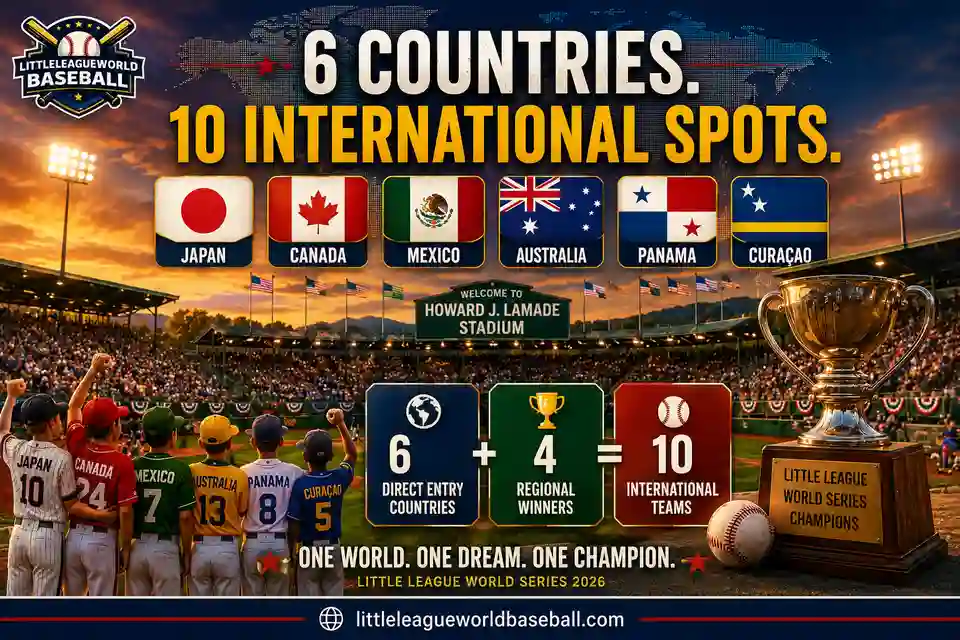
When the 2026 Little League World Series bracket was released, six international teams already had their spots locked in. Japan, Canada, Mexico, Australia, Panama, and Curaçao were all confirmed before a single regional game was played. Meanwhile, South Korea, the Dominican Republic, Nicaragua, Czechia, and other countries had to win their regional tournaments to earn a spot.
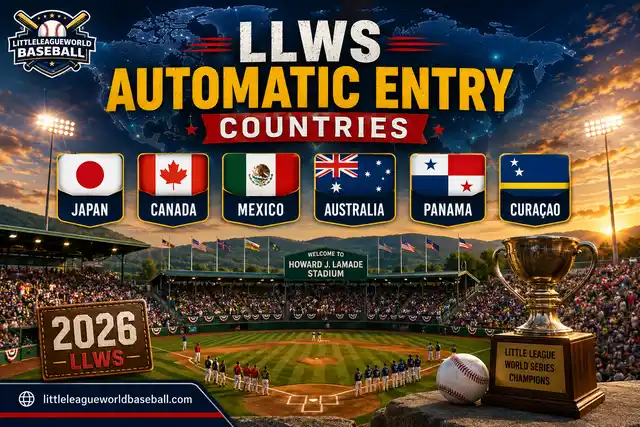
| Permanent Direct Entry | Japan, Canada, Mexico, Australia |
| Rotation Direct Entry 2026 | Panama and Curaçao |
| Rotation Countries | Cuba, Panama, Puerto Rico, Curacao |
| Rotation Started | 2022, when tournament expanded to 20 teams |
| Who Decides | Little League International Tournament Committee |
| How Selected | Random lottery for rotation spots |
That seems unfair at first glance. Why do some countries get a free pass while others have to win their way in? The answer involves program history, travel logistics, community impact, a formal rotation system, and a random lottery drawn in November 2020. This guide explains all of it.
Two Ways to Reach the LLWS as an International Team
Every international team at the LLWS gets there in one of two ways. They either win their regional qualifying tournament. The same way US teams earn their spots, or they receive direct entry and skip the regional round entirely.
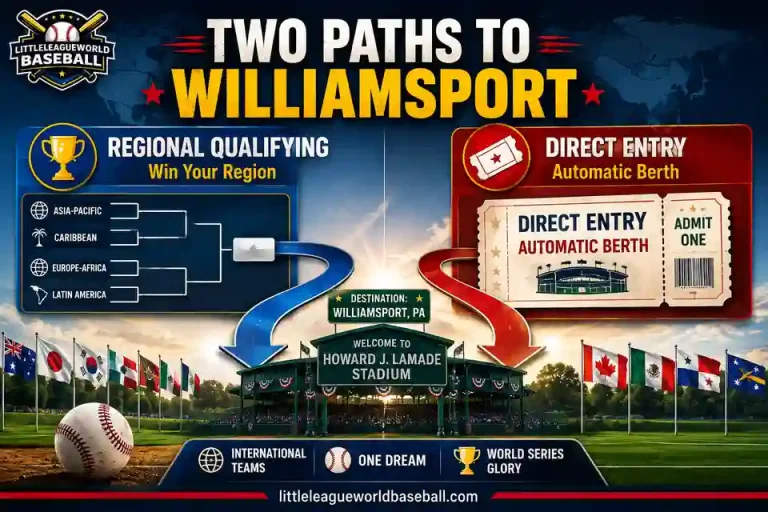
| Entry Type | How It Works | Countries in 2026 |
|---|---|---|
| Regional Qualifying | Win the regional tournament for your area, Asia-Pacific, Caribbean, Europe-Africa, or Latin America | South Korea, Dominican Republic, Nicaragua, Czechia – all won their regions |
| Permanent Direct Entry | Automatic LLWS spot every year – no regional qualifying required | Japan, Canada, Mexico, Australia |
| Rotation Direct Entry | Automatic spot on a rotating schedule – different countries each year | Panama and Curaçao in 2026 |
The 10 international spots breakdown in 2026: 4 permanent direct entry countries (Japan, Canada, Mexico, Australia). 2 rotation direct entry countries (Panama, Curaçao). 4 regional qualifying winners (Asia-Pacific, Caribbean, Europe-Africa, Latin America). Total: 10 international teams at Williamsport.
Why Does Little League Give Direct Entry at All?
Little League International created the direct entry system to solve real problems – not to play favorites. Three factors drive every direct entry decision.
Factor 1: Program Size and Community Fabric
Little League International looks at whether Little League is genuinely embedded in the culture of a country, not just how many leagues exist, but whether the game is central to how communities operate. Patrick Wilson, Little League President and CEO, explained this directly when announcing the 2026 direct entries.
Our goal is to continue expanding that World Series opportunity to as many countries with passionate Little League programs, evaluating not just the number of Little League programs within a country, but also whether Little League is truly the fabric of communities, as we determine direct entries and region alignment for our tournaments. “Patrick Wilson, Little League President and CEO, February 2026“
Factor 2: International Travel Logistics
Getting a team of 12-year-olds from Japan or Australia to Williamsport, Pennsylvania requires international flights, visas, significant planning, and expense. Little League International funds housing, meals, and accommodations for every team at the World Series. But international travel costs fall on the teams themselves.
Requiring Japan or Australia to first win a regional tournament, often held just weeks before the World Series. And then scrambling to organize international travel on short notice creates logistical problems that direct entry resolves. Guaranteed spots allow those countries to plan their travel months.
Factor 3: Tournament History and Competitive Record
Countries with deep LLWS history and strong competitive records anchor the international field. Japan has 11 LLWS championships and 35 appearances. Mexico has 38 appearances dating to 1957, including 3 titles. Canada has 65 appearances. Australia has competed since the 1990s. These programs built the international identity of the LLWS. Direct entry reflects that relationship.
| Direct Entry Criteria | Weight |
|---|---|
| Little League program depth and community integration | Primary factor |
| International travel distance and logistics | Primary factor |
| LLWS appearance history | Strong consideration |
| Number of chartered leagues in the country | Considered but not the only factor |
| Competitive record at Williamsport | Considered |
| Grassroots program growth | Considered |
The Four Countries With Permanent Direct Entry
Four countries receive automatic LLWS entry every single year. They do not participate in the rotation. Their spots are guaranteed regardless of regional results.
Japan
LLWS
35
Appearances
Championships
11
–
Championship Game
16
Appearances
Direct
2007
Since
Japan has had direct entry every year since 2007. No other country has a stronger LLWS record. Japan has won 11 championships in 35 appearances and made the championship game 16 times. The distance from Japan to Williamsport, roughly 13 hours of flying, makes advance travel planning essential.
Japan also runs one of the most organized and largest Little League programs in Asia, with hundreds of chartered leagues. In 2026, Joto Little League from Tokyo represents Japan after going 4-0 in the Japan Region Tournament.
Canada
LLWS
65
Appearances
Championships
0
–
Only Final
1965
Runner-Up
Direct
Early event years
Since
Canada has 65 LLWS appearances, more than any other international country. Little League has been part of Canadian baseball culture since the 1950s. British Columbia has represented Canada at the LLWS 30 times.
The Canada-US relationship in Little League is the longest international partnership in the tournament’s history. Canada’s direct entry reflects both the depth of its program and its role in making the LLWS a truly international event from the beginning.
Mexico
LLWS
38
Appearances
Championships
3
1957, 1958, 1997
All-Time
81-63
Record
Direct
Long-standing
Since
Mexico has 38 LLWS appearances dating to 1957, when Monterrey became the first international team to win the LLWS championship. Angel Macias threw the first perfect game in championship history that year.
Mexico has 3 championships (1957, 1958, 1997), 4 runner-up finishes, and an 81-63 record. Mexico’s direct entry is built on this deep historical foundation and is one of the largest Little League communities in Latin America.
Australia
Received Own
2013
Berth
Direct
since 2013
Entry
Furthest international
Distance
team from Williamsport
Australia received its own dedicated LLWS berth starting in 2013, which triggered a reorganization of the international regions. The Europe Region became the Europe and Africa Region when African countries were added to fill the gap created by Australia’s separation.
Australia’s direct entry reflects the distance factor more than any other country; flying from Australia to Williamsport requires crossing nearly the entire planet. Direct entry guarantees Australian teams enough advance notice to organize that journey. Australia competes in Little League across multiple states with a growing grassroots program.
How the Direct Entry Rotation System Works
In 2019, Little League announced it would expand the LLWS from 16 to 20 teams starting in 2022. Two additional US regions were created: Metro and Mountain. On the international side, two additional spots were created through a direct entry rotation system.
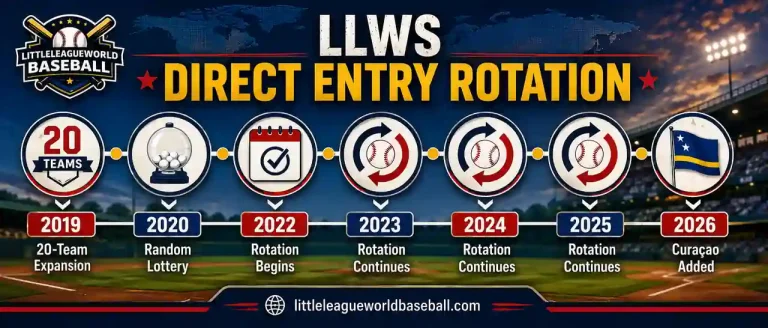
Rather than giving those two extra international spots to regional qualifying winners, Little League created a rotating pool of countries that take turns receiving automatic entry. The original three-country rotation pool was Cuba, Panama, and Puerto Rico. Two of the three receive direct entry each year. The third must qualify through its regional tournament.
2019 –Expansion Announced
Little League announces LLWS expansion to 20 teams starting in 2022. A rotation system was created for international direct entry spots.
2020 –Random Lottery Drawn
Antonio Gonzalez and Serafin Gomez III — Latin America Region field directors – draw the rotation order at random. Panama and Puerto Rico got 2022. Rotation set through 2024.
2022 –First Expansion Year
Panama and Puerto Rico receive direct entry. Cuba must qualify through the Latin American Regional. The first 20-team LLWS was held in Williamsport.
2023 –Rotation Continues
Cuba and Panama receive direct entry. Puerto Rico must qualify through the regional tournament.
2024 –Third Year of Rotation
Cuba and Puerto Rico receive direct entry. Panama must qualify through the regional tournament.
2025 –Rotation Continues
Panama and Puerto Rico receive direct entry based on the rotation schedule.
2026 –Curaçao Added to Rotation
Little League International Tournament Committee adds Curaçao to the rotation pool. Panama and Curaçao receive 2026 direct entry. Cuba and Puerto Rico must qualify through regional tournaments.
Why Curaçao was added in 2026: Patrick Wilson cited Curaçao’s long-standing commitment to Little League at both the grassroots and tournament level. Pariba Little League from Willemstad, the same league Ozzie Albies and Andrew Jones both played for, is one of the most storied programs in Caribbean Little League. Curaçao was added to expand direct entry to countries where Little League is genuinely central to community life.
| Year | Direct Entry Countries | Must Qualify |
|---|---|---|
| 2022 | Panama, Puerto Rico | Cuba |
| 2023 | Cuba, Panama | Puerto Rico |
| 2024 | Cuba, Puerto Rico | Panama |
| 2025 | Panama, Puerto Rico | Cuba |
| 2026 | Panama, Curaçao | Cuba, Puerto Rico |
Is the Direct Entry System Fair to Other Countries?
This is the most common question fans ask about direct entry. The honest answer is that it depends on what you mean by fair.
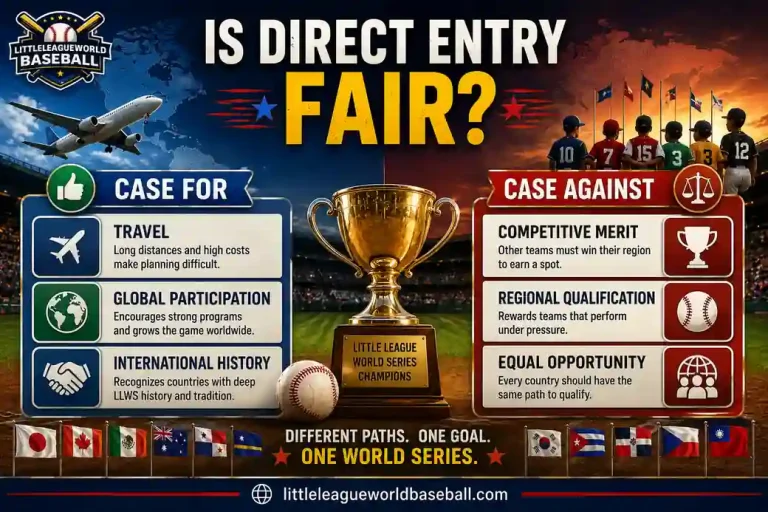
The Case For Direct Entry
The system serves a purpose that pure merit-based qualifying cannot. Japan and Australia face 13-hour flights to reach Williamsport. Requiring them to play a regional tournament just weeks before the World Series makes international travel nearly impossible.
Canada has built the longest international relationship with Little League in tournament history. Removing direct entry for these countries would likely reduce international participation, not improve it.
The rotation system also gives countries like Panama, Puerto Rico, Cuba, and Curaçao a guaranteed spot on a fair schedule. None of them gets every year; they rotate. And the third country in the rotation can still qualify through its regional tournament. Direct entry is not the only path.
The Case Against Direct Entry
A team from South Korea must go 6-0 through the Asia-Pacific Region Tournament and beat Chinese Taipei 3-1 in the final to earn an LLWS spot. A team from the Dominican Republic must win the Caribbean Regional. A team from Czechia must win the Europe-Africa Regional. Meanwhile, Japan gets a spot automatically because of what its Little League program accomplished decades ago.
From a pure competitive fairness standpoint, every country should have to qualify. The counterargument is that the LLWS is not just a competitive tournament — it is also a celebration of international baseball culture, and that requires making international participation logistically viable for countries that would otherwise struggle to organize it.
The balance Little League strikes: Six of the 10 international spots go to direct-entry countries. Four go to the regional qualifying winners. That means four competitive programs from around the world earn their spots on pure merit every year. The system tries to balance historical relationships and logistical reality with competitive qualification.
Could More Countries Join the Direct Entry System?
The addition of Curaçao in 2026 shows that Little League International actively evaluates the rotation pool. The criteria are clear: program depth, community integration, and travel logistics. Countries that build strong Little League programs with genuine grassroots participation are the ones that get considered.
| Country | LLWS Appearances | Titles | Direct Entry Status |
|---|---|---|---|
| Japan | 35 | 11 | Permanent |
| Canada | 65 | 0 | Permanent |
| Mexico | 38 | 3 | Permanent |
| Australia | Since 2013 | 0 | Permanent |
| Panama | 10+ | 0 | Rotation |
| Curacao | Multiple | 1 | Rotation (new 2026) |
| Cuba | Multiple | 0 | Rotation |
| Puerto Rico | 11 since 1959 | 0 | Rotation |
| Chinese Taipei | 18 titles | 18 | Must qualify through Asia-Pacific |
| South Korea | 8 | 3 | Must qualify through Asia-Pacific |
| Venezuela | Multiple | 2 | Must qualify through Latin America |
| Dominican Republic | 10 | 0 | Must qualify through Caribbean |
Conclusion
Six countries will receive automatic LLWS entry in 2026. Japan, Canada, Mexico, and Australia hold permanent spots built on decades of program history, community integration, and logistical necessity. Panama and Curaçao hold rotation spots as part of a system introduced when the LLWS expanded to 20 teams in 2022.
The rotation was drawn by random lottery in November 2020 and has evolved since – most recently when Curaçao joined the pool in 2026. The four remaining international spots go to regional qualifying winners who earn their place on merit. The system balances competitive fairness with the practical reality of making the LLWS a genuinely global tournament.