Little League Baseball Gear Guide 2026: Bats, Gloves, Helmets
Buying the wrong bat or helmet does not just waste money. It gets your player disqualified before they step on the field. Little League International enforces strict equipment rules at every level, and 2026 brought several important changes that every parent and coach needs to know.
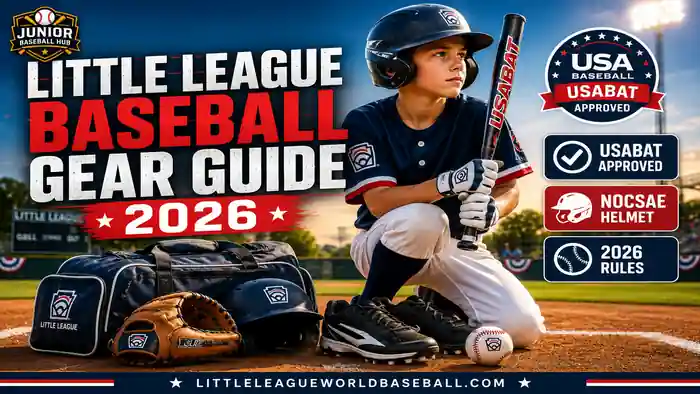
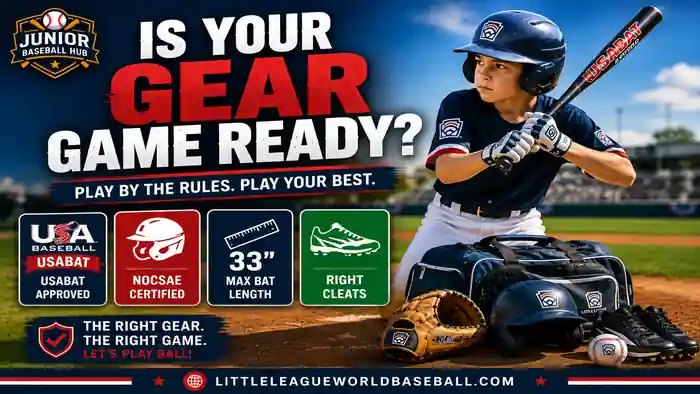
| Bat Standard | USABat to USA Baseball stamp required |
| Max Bat Length | 33 inches |
| Helmet Standard | NOCSAE certified with no alterations |
| Max Bat Diameter | 2 5/8 inches |
| New in 2026 | Pine tar and thumb protectors now allowed |
| Still Banned | BPF 1.15 bats, choke-knobs, choke-up assists |
This guide covers everything from the required gear, approved standards, what changed in 2026, equipment rules by division, and exactly how to check if your gear is legal before game day.
Required Equipment Checklist for Little League 2026
Here is all the equipment your player needs before their first game. Little League rules require green items. Gold items are recommended but optional.
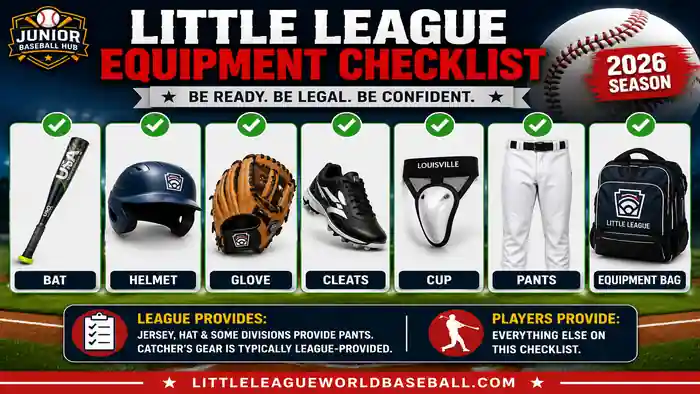
Baseball Glove
Required. The player must provide their own. Size depends on position and age. See the glove guide below.
Batting Helmet to NOCSAE Certified
Required. Must bear the NOCSAE stamp. No aftermarket modifications allowed.
Baseball Cleats
Required. Non-metal cleats only for the Majors division and below. Metal cleats are allowed in Intermediate, Junior, and Senior League.
Protective Cup to Boys Only
Required for all boys in Little League Baseball at every division level.
Baseball Pants
Required for Instructional level and above. Check with your coach for color requirements before purchasing.
Baseball Bat to USABat Certified
Recommended. Many leagues provide loaner bats. If buying your own, a USA Baseball stamp is required.
Batting Gloves
Optional. Not required by Little League rules. Personal preference only.
Sliding Shorts
Optional. Recommended for Instructional level and above. Protects thighs when sliding.
Equipment Bag
Optional but very useful. Keeps all gear organized between games and practices.
What Little League provides: Your league provides the jersey, hat, and in some divisions the game pants. A catcher’s gear is also typically league-provided. Players are responsible for everything else on this list.
What Bats Are Legal in Little League 2026?
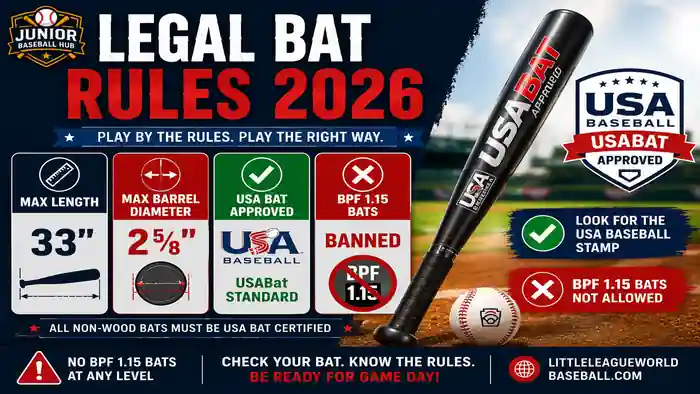
All non-wood bats used in Little League Majors division and below must meet the USABat standard. This means the bat must display the USA Baseball certification stamp. Without that stamp, the bat is illegal, and the player faces disqualification.
| Bat Specification | Requirement |
|---|---|
| Maximum Length | 33 inches |
| Maximum Diameter | 2 5/8 inches (barrel) |
| Minimum Wood Diameter | 15/16 inch at the smallest part (7/8 inch for bats under 30 inches) |
| Tape or Sleeve | Maximum 16 inches from the small end |
| Non-Wood Bats | Must bear the USA Baseball logo to the USABat standard |
| Wood Bats | No USA Baseball stamp required |
| BPF 1.15 Bats | Banned at all levels |
| Grip | Cork, tape, or composition material to a minimum of 10 inches from small end |
Wood bats do not require the USA Baseball stamp. Solid one-piece wood bats are legal at all levels without any certification marking.
Common mistake: Many parents still buy BPF 1.15 bats, thinking they are legal. They are not. BPF 1.15 bats have been banned since the 2018 USABat rollout. If your bat does not have the USA Baseball stamp, it cannot be used in any Little League game.
2026 Bat Rule Changes to What Is New This Season
Little League published its 2026 rule changes in January 2026. Several equipment rules changed. Here is exactly what is different this season.
| Rule | Change in 2026 | Status |
|---|---|---|
| Pine Tar | Now permitted at all levels of Little League Baseball and Softball | New to Allowed |
| Thumb Protectors | Now permitted for batters at all levels | New to Allowed |
| Choke-Knobs | Not permitted to rule clarified in 2026 | Still Banned |
| Choke-Up Assists | Not permitted to rule clarified in 2026 | Still Banned |
| Illegal Bat Rule | Rule 6.06(d) reworded for consistency with Tournament Rule 3(b) | Clarified |
Pine tar in 2026: Little League now allows pine tar and similar adhesive substances at all levels. This aligns youth baseball with standard MLB practice. Players can apply pine tar to their bat handle up to 18 inches from the knob.
Helmet Rules to What Little League Requires in 2026
Every batter in Little League Baseball must wear a helmet. The helmet must bear the NOCSAE stamp to the National Operating Committee on Standards for Athletic Equipment certification. A helmet without this stamp is illegal in Little League play.
C-flap rule: The C-flap is popular in youth baseball because MLB players wear them. But adding an aftermarket C-flap to a Little League helmet is not permitted. It must be manufacturer-installed. If you want a C-flap, buy a helmet that comes with one already attached.
Gloves to Size Guide by Position and Age
Glove size matters more than most parents realize. An oversized glove slows down a young player’s transfer speed and makes it harder to develop proper fielding mechanics. Buy the right size for the position.
| Position | Recommended Size | Age Group |
|---|---|---|
| T-Ball / Farm | 8 to 9 inches | Ages 4 to 7 |
| Infield (all positions) | 10 to 11.75 inches | Ages 8 to 12 |
| Pitcher | 11.5 to 12.25 inches | Ages 9 to 12 |
| Outfield | 11.5 to 12.25 inches | Ages 9 to 12 |
| First Base | 12 to 12.5 inches | Ages 10 to 12 |
| Catcher | League-provided to a 32 to 33-inch circumference | All ages |
| Intermediate and Junior | 11.5 to 12.5 inches | Ages 12 to 14 |
Breaking in tip: Most gloves need a break-in period. The best way to break in a new glove is simply to use it. Play catch with it daily. Do not microwave it, soak it in oil, or use rubber bands overnight. Those methods damage the leather.
Little League Equipment Rules by Division
Equipment rules are not the same across every division. Metal cleats, bat standards, and helmet requirements vary depending on which level your player competes at. Here is the full breakdown.
| Division | Bat Standard | Metal Cleats | Helmet Notes |
|---|---|---|---|
| Tee Ball and Minor | USABat stamp required | Not allowed | NOCSAE required, league often provides loaners |
| Majors (11-12) | USABat stamp required. Max 33 inches, 2 5/8 diameter | Not allowed | NOCSAE required, no modifications |
| Intermediate 50/70 (12-13) | USABat or BBCOR | Allowed | NOCSAE required |
| Junior League (13-14) | USABat or BBCOR | Allowed | NOCSAE required |
| Senior League (14-16) | BBCOR only | Allowed | NOCSAE required |
Senior League parents note: Senior League requires BBCOR bats only. USABat bats are not legal at the Senior League level. If your player moves up to Senior League and brings their old Majors bat, it will be confiscated before the game.
League Equipment vs Personal Equipment
One of the most common questions new Little League parents ask is what the league provides and what they need to buy themselves. Here is the exact breakdown.
| Item | League Provides | Player Buys |
|---|---|---|
| Jersey | Yes | – |
| Hat | Yes | |
| Game Pants | Some divisions only | Player buys if not provided |
| Batting Helmets | Loaner helmets available | Most players bring their own |
| Catcher’s Gear | Yes to full set | – |
| Baseballs | Yes | – |
| Baseball Glove | – | Player buys |
| Bat | Some leagues provide loaners | Recommended to own a personal bat |
| Cleats | – | Player buys |
| Protective Cup | – | Player buys |
| Equipment Bag | – | Optional for the player to buy |
| Batting Gloves | – | Optional for the player to buy |
What LLWS Players Actually Wear at Williamsport
Players at the Little League World Series in Williamsport wear gear provided by official partners. The experience is different from local league play, as every player receives professional-level equipment for the tournament.
Adidas unveiled the official 2026 LLWS uniform featuring the ADIZERO Racing design. All 20 teams wear the same kit at Lamade Stadium and Volunteer Stadium. The uniform uses motorsports-inspired styling with lightweight performance fabric. Read the full breakdown in our 2026 LLWS Uniforms guide.
Umpires at the 2026 LLWS wear uniforms provided by Gerry Davis Sports as the official umpire uniform provider. All 20 Williamsport umpires receive the full kit. Read more in our 2026 LLWS Umpires guide.
Gear Buying Mistakes to Avoid in 2026
These are the most common equipment mistakes parents make. Every one of them can get a player removed from a game before they ever bat.
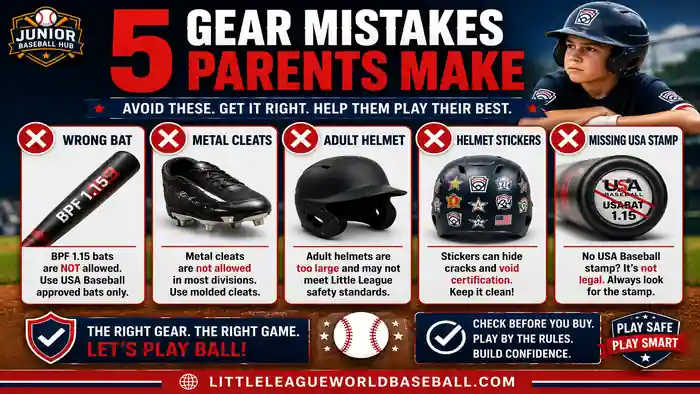
Buying a BPF 1.15 Bat
BPF 1.15 bats were banned in 2018 when the USABat standard replaced the old system. Many retailers still sell old stock. Always check for the USA Baseball stamp, not the BPF rating.
Using an Old BBCOR Bat in the Majors Division
BBCOR bats are legal in Intermediate, Junior, and Senior League. They are not legal in the Majors division and below. A BBCOR bat without a USABat stamp gets confiscated at the field.
Buying an Adult-Size Batting Helmet
An adult helmet that does not fit snugly on a child’s head is a safety hazard and an equipment violation. The helmet must stay secure without wobbling. Always try before buying.
Adding Stickers or Paint to a Helmet
Any aftermarket alteration to a batting helmet can void the NOCSAE certification. No stickers, no paint, no drilling unless the manufacturer explicitly permits it in writing.
Wearing Molded Football Cleats
Football cleats have a toe cleat at the front that is not present on baseball cleats. That toe cleat is dangerous when sliding and is illegal in Little League Baseball at all levels.
Ignoring the USA Baseball Stamp on the Bat
The USA Baseball stamp is not optional. It is mandatory for all non-wood bats in the Majors division and below. If the stamp is not visible on the barrel, the bat is illegal. Do not assume to check every bat before purchasing.
Buying Metal Cleats for the Majors Division
Metal cleats are not permitted in the Majors division and below. They are only allowed to start in the Intermediate 50/70 division. Molded rubber cleats are required for younger divisions.
How to Check If Your Equipment Is Little League Approved
Do this check before the first game of the season. Equipment inspections happen at the field. Illegal gear gets pulled on the spot.
1- Find the USA Baseball Stamp on the Bat
Look on the barrel of the bat, just above the grip area. The USA Baseball logo is printed directly on the barrel. If you see BPF 1.15 instead, the bat is illegal. If you see BBCOR, check which division your player is in.
2- Find the NOCSAE Stamp on the Helmet
The NOCSAE stamp is inside the helmet, typically printed on the inner liner or back panel. It must be visible and intact. A worn or missing stamp means the certification may be void.
3- Measure the Bat Length and Diameter
Use a tape measure. The bat must not exceed 33 inches in length or 2 5/8 inches in diameter at the barrel. Most bats have the length printed near the knob. Measure the diameter at the widest point of the barrel.
4- Check for Helmet Modifications
Inspect the entire helmet surface. Look for drill holes, added stickers, paint, or attached accessories. Any modification that was not done by the manufacturer voids the NOCSAE certification.
5- Verify at LittleLeague.org
Little League publishes an approved bat list at LittleLeague.org/playing-rules/bat-information. If your bat is not on the list, it is not legal. Check before game day, not during warmups.
Ask your District Administrator: If you are not sure whether a specific piece of equipment is legal for your division, contact your league’s District Administrator. They have the final word on equipment compliance at your level of play.
Conclusion
Little League equipment rules exist to keep players safe and the game fair. The USABat standard covers all non-wood bats in the Majors division and below. NOCSAE helmets are required at every level. Metal cleats are not permitted until the Intermediate division. Pine tar and thumb protectors are new for 2026. Check every piece of gear before the first game using the five-step process above.