
Little League Baseball World Series Injuries: Complete Guide
The Little League World Series is one of the safest youth baseball environments in the world. Little League International invests heavily in player safety. Medical staff at both Williamsport stadiums support pitch count rules backed by clinical research.
| Most Serious Injury | Easton Oliverson to skull fracture, 2022 |
| Biggest On-Field Risk | Arm overuse to UCL and shoulder injuries |
| Pitch Counts Since | 2007, to prove that Tommy John risk can be reduced |
| Medical Partner | UPMC Player Wellness Center |
| Bunk Beds Removed | Permanently to after 2022 incident |
| Fatigue Risk Multiplier | 36x greater injury risk when fatigued |
But injuries do happen. Some happen on the field. Some happen off it. This guide covers both, including the most serious injury in LLWS history, what the science says about arm injuries, and every safety change Little League has made since.
Easton Oliverson: The Most Serious Injury in LLWS History (2022)
On August 15, 2022, 12-year-old Easton Oliverson fell from a top bunk bed at the LLWS dormitory complex in Williamsport. The Snow Canyon pitcher from Santa Clara, Utah, fractured his skull and suffered a brain hemorrhage. Doctors airlifted him to Geisinger Janet Weis Children’s Hospital in Danville, Pennsylvania.
Surgeons operated within hours. They removed a portion of his skull to allow the brain to swell safely. Easton went into a medically induced coma. His family created the Instagram account @miraclesfortank to share updates with the thousands of people following his recovery.
What doctors said: Dr. Oded Goren, a neurosurgeon at Geisinger Medical Center, told reporters Easton’s recovery was “just fantastic.” He added, “The images look fantastic, and taking his clinical progression to that is doing so well that I am hopeful for full recovery.” Statistically, according to Easton’s uncle, doctors said he should not have survived.
Mookie Betts, Easton’s favorite MLB player, sent a personal video message to the hospital. The Los Angeles Dodgers outfielder told him he was praying for him and hoped to see him soon. The BYU football team also sent a video. Support came from across the country.
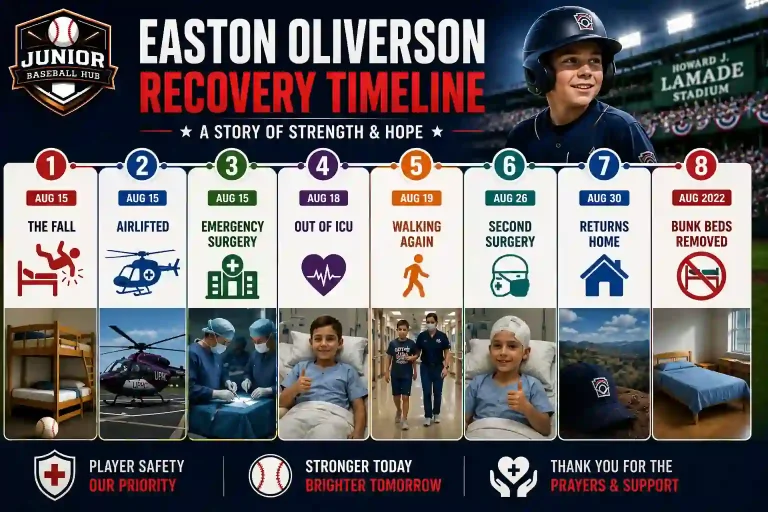
1- The Fall
Aug 15, 2022
Easton falls from the top bunk at the 12-year-old players’ dorm. Skull fractures on impact. A punctured artery causes bleeding in the brain.
2- Emergency Surgery
Aug 15, 2022
Airlifted to Geisinger Janet Weis Children’s Hospital. Brain surgery was performed to remove the hematoma. Portion of skull removed to allow swelling. Medically induced coma follows.
3- Little League Responds
Aug 16, 2022
Little League International issues a statement. Announces it will remove all bunk beds from the dormitory complex immediately.
4- Out of ICU
Aug 18, 2022
Easton moves out of intensive care into a regular hospital room. Starts communicating with family. His brother Brogan flies in to take his roster spot at the LLWS.
5- Walking Again
Aug 19, 2022
Family shares a video of Easton walking with medical personnel. “God is good,” the family posts on Instagram.
6- Second Surgery
Aug 26, 2022
Doctors successfully replace the portion of the skull removed during the first procedure. Surgery goes perfectly. Easton stays overnight in PICU for observation.
7- Leaves Hospital
Aug 30, 2022
Easton transfers from Geisinger to a facility in Utah to continue recovery closer to home. Full recovery expected.
8- Lawsuit Filed
Sept 2023
Easton’s parents, Jace and Nancy Oliverson, filed a negligence lawsuit in Philadelphia against Little League and the bed manufacturer. The lawsuit notes the top bunk had no guardrail.
What changed permanently: Little League removed all bunk beds from the Williamsport dormitory complex in August 2022. The change is permanent. From 2023 onward, every player sleeps on a single bed on the floor. Little League noted it had used institutional bunk beds since 1992 and was unaware of any prior serious injuries before Easton’s fall.
On-Field Injuries at the LLWS
On-field injuries at the LLWS are rare. The tournament runs for 12 days with games across two fields. Little League maintains Lamade Stadium and Volunteer Stadium to professional standards to reduce surface-related risks.
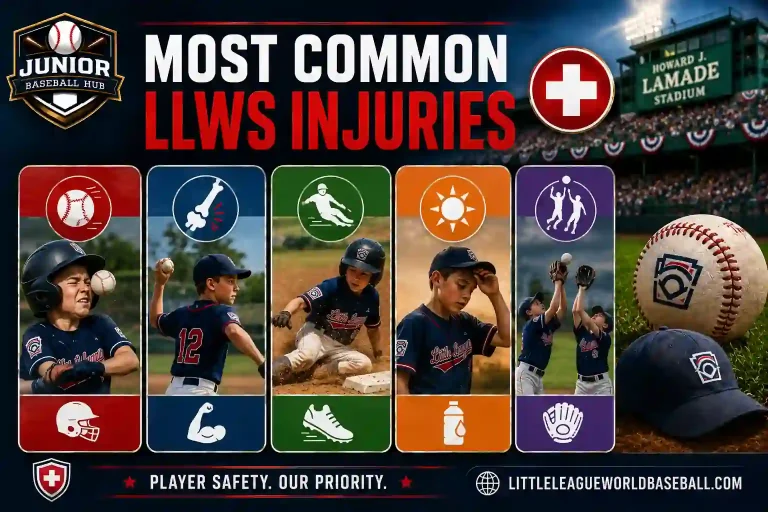
| Injury Type | Common Cause | Risk Level |
|---|---|---|
| Hit by a pitch | Fastball contact to the face, hands, or ribs | Moderate |
| Sliding injuries | Ankle twists, abrasions on base slides | Low |
| Outfield collisions | Two fielders chasing the same ball | Moderate |
| Arm overuse | Too many pitches are causing UCL and shoulder stress | High |
| Batted ball contact | Line drives to infielders or pitchers | Moderate |
| Heat exhaustion | August heat in Williamsport during daytime games | Moderate |
UPMC serves as the official medical partner for the Little League World Series through its Player Wellness Center at the complex. Medical personnel are stationed at both Lamade Stadium and Volunteer Stadium throughout the entire tournament.
Arm Injuries: The Biggest Risk for LLWS Pitchers
Arm injuries are the most significant long-term health risk for any youth baseball pitcher. At the LLWS level, pitchers throw harder and more frequently than at any other stage of Little League. That makes arm health the most important medical topic in the entire tournament.
What Is Little Leaguer’s Elbow?
Little Leaguer’s Elbow is a stress injury to the growth plate on the inner side of the elbow. Young pitchers experience micro-tearing of the ulnar collateral ligament with each throw. Without adequate rest, the UCL stretches, weakens, and eventually fails. The condition is directly caused by overuse at a young age.
Tommy John Surgery in Youth Players
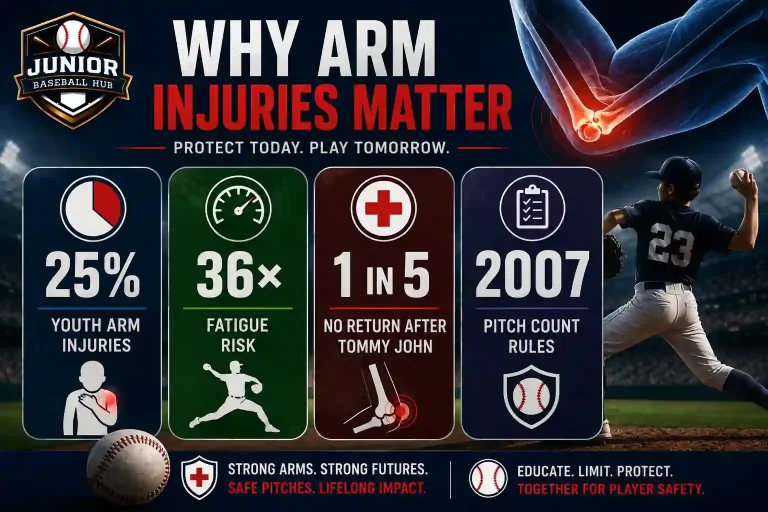
Tommy John surgery, for ulnar collateral ligament reconstruction, is now the fastest-growing surgical procedure among 15 to 19-year-olds in sports medicine. A 2023 study in the Journal of Shoulder and Elbow Surgery tracked 261 youth and high school pitchers. It found that 25 percent of them experienced a serious arm injury over their playing careers.
25%
Youth pitchers with arm injuries
36x
Greater injury risk when fatigued
1 in 5
Tommy John patients never return to the prior level
2007
Year pitch count rules replaced inning limits
Critical fact: Research from the American Sports Medicine Institute in Birmingham, Alabama confirmed that a fatigued young baseball player has a 36-to-1 greater chance of injuring their throwing shoulder or elbow. Fatigue is the number one driver of arm injuries, not mechanics, not pitch type.
Why Curveballs Are Dangerous Before Puberty
Little League strongly discourages curveballs for players who have not yet gone through puberty. The curveball requires a highly sophisticated neuromuscular motion. Young players have underdeveloped ulnar collateral ligaments. Throwing curveballs before the bones mature puts direct stress on a structure that cannot yet handle it.
Do Pitch Count Rules Actually Prevent Injuries?
Yes, and a landmark study using LLWS data proved it. Researchers tracked all LLWS pitchers from 2001 through 2009. They then checked which of those pitchers went on to play professional baseball and which required Tommy John surgery.
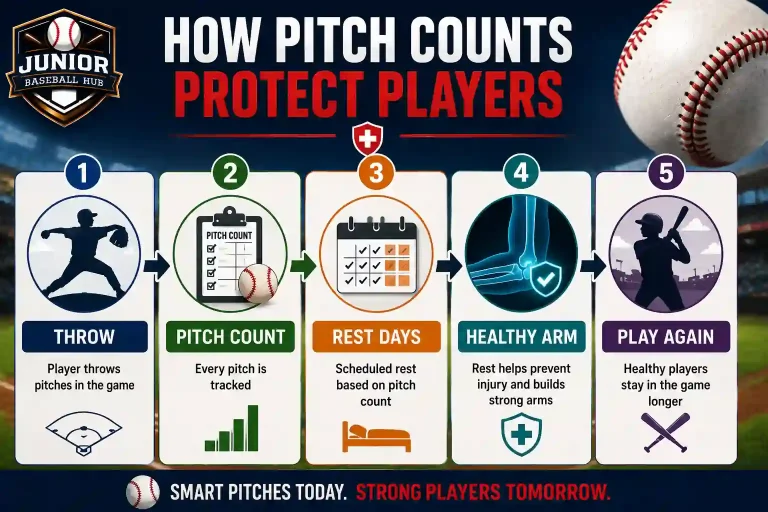
The results were clear. Every former LLWS pitcher who went professional and required Tommy John surgery had played in the LLWS before 2007, when inning limits replaced pitch count rules. No pitcher who played after the 2007 pitch count rules took effect went on to require the surgery as a professional. The study confirmed that pitch count limits work.
What changed in 2007: Little League replaced its inning-based limits with specific pitch count maximums by age. The 2007 rules also introduced mandatory rest day requirements based on pitches thrown. These rules are still in place and form the basis of the 2026 LLWS pitch count regulations.
Use our LLWS Pitch Count Tracker to monitor pitch counts in real time during any game to build to the official 2026 Little League limits.
Little League Pitch Count and Rest Day Rules 2026
Little League sets strict pitch count limits by age. Coaches must track every pitch and enforce mandatory rest days. Violations result in the pitcher becoming ineligible for further tournament play.
| Age | Daily Max Pitches | Rest Required |
|---|---|---|
| Ages 7–8 | 50 | 66+ pitches: 4 days rest. 51–65: 3 days. 36–50: 2 days. 21–35: 1 day. |
| Ages 9–10 | 75 | 66+ pitches: 4 days rest. 51–65: 3 days. 36–50: 2 days. 21–35: 1 day. |
| Ages 11–12 | 85 | 66+ pitches: 4 days rest. 51–65: 3 days. 36–50: 2 days. 21–35: 1 day. |
| Ages 13–16 | 95 | 66+ pitches: 4 days rest. 51–65: 3 days. 36–50: 2 days. 21–35: 1 day. |
Pitch Smart program: USA Baseball and Major League Baseball jointly developed Pitch Smart to give coaches, parents, and players a science-based framework for managing pitch workloads. Little League uses Pitch Smart guidelines as a foundation for its official pitch count regulations. The program is available free at PitchSmart.org.
What Happens If a Player Gets Injured at the LLWS?
Little League has a formal injury protocol at Williamsport. Medical staff from UPMC’s Player Wellness Center cover both stadiums throughout the tournament. Players receive an on-site evaluation before any decision about further care.
Safety Changes After Easton Oliverson’s Injury
Easton Oliverson’s 2022 injury prompted the most significant safety change in LLWS dormitory history. Little League acted within 24 hours of the incident.
| Change | When | Status |
|---|---|---|
| All bunk beds removed from dorms | August 16, 2022 | Permanent |
| Single beds only to floor level | August 16, 2022 | Permanent |
| Dorm safety review completed | 2023 preseason | Done |
| UPMC Player Wellness partnership | Ongoing | Active |
Little League noted that it had used institutional bunk beds since 1992 without a reported serious injury in that period. The organization did not wait for the investigation to conclude before acting. Bunk beds came out immediately after Easton’s fall.
How Little League Protects Players in 2026
Little League International runs the most comprehensive player safety program of any youth baseball organization in the world. Here is what that looks like in 2026.
Conclusion
Injuries at the Little League World Series are rare. When they happen, Little League responds. Easton Oliverson’s 2022 skull fracture changed dormitory safety permanently. Pitch count science confirmed in 2007 has protected thousands of young arms since.
In 2026, UPMC medical staff will cover every game at both Williamsport stadiums. The rules, the research, and the resources are all in place. Little League takes player safety as seriously as it takes the game itself.