2026 LLWS Photography Tips: Best Spots to Capture the Action
The Little League World Series is one of the most photogenic sporting events in America. Two stadiums are nestled into the side of Bald Eagle Mountain. A famous grass hill packed with 40,000 fans. Flags from 20 countries line the complex. Kids from around the world are playing the biggest game of their lives. The photo opportunities are everywhere, if you know where to stand.
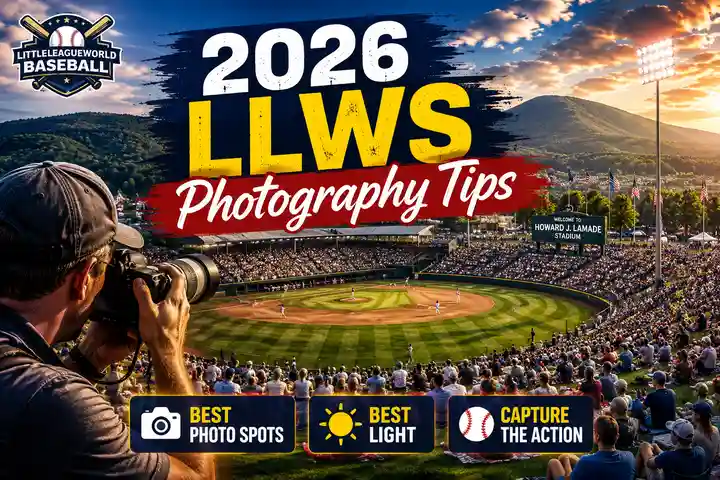
| Best Morning Spot | Third base side – sun at your back |
| Best Afternoon Spot | Top of the hill – wide stadium shots |
| Best Evening Spot | First baseline – stadium lights angle |
| Best Emotional Shots | Dugout level – reactions, not plays |
| Best Crowd Shot | Behind home plate from upper level |
| Professional Camera | Not permitted without media credential |
| Phone Photography | Fully permitted everywhere fans are allowed |
| Video Streaming | Strictly prohibited – copyright violation |
This guide covers the best shooting spots at both Lamade Stadium and Volunteer Stadium, the best times of day for each location, camera and phone settings for sports photography in August sun, what gear to bring, and the rules every photographer needs to know before they arrive.
Understanding Lamade Stadium and Volunteer Stadium for Photography
The two stadiums at the LLWS complex are completely different shooting environments. Understanding how each one is oriented, relative to the sun and crowd, is the foundation of planning your shots.
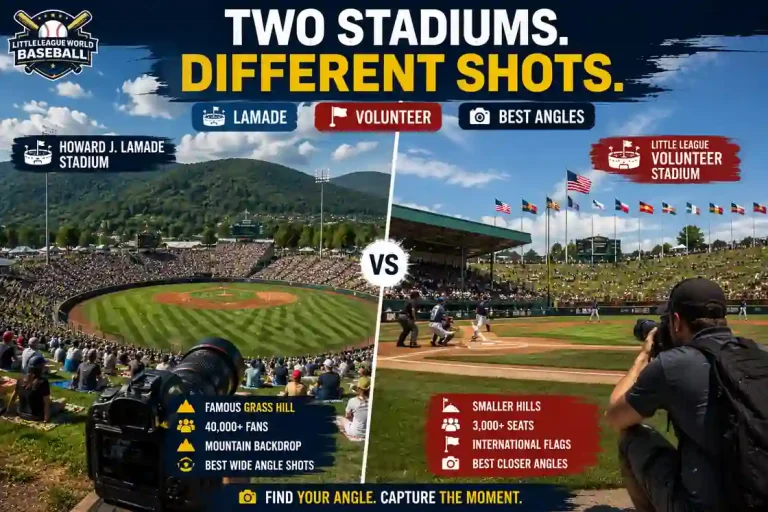
| Feature | Howard J. Lamade Stadium | Little League Volunteer Stadium |
|---|---|---|
| Opened | 1959, renovated 2026 | 2001 |
| Capacity | 10,000 seats plus 40,000 on the berm hill | 3,000 seats plus 5,000 on smaller berms |
| Surface | Kentucky Bluegrass | Kentucky Bluegrass |
| Fence Distance | 225 feet all around | 225 feet all around |
| Orientation | Home plate faces roughly northeast – afternoon sun hits the field from southwest | Similar orientation – check sun position on game day |
| Hill Photography | Famous berm hill above left-center – iconic backdrop | Smaller berms, less dramatic hill shots |
| Games Hosted | US bracket games, elimination rounds, championships | International bracket games, early rounds |
| Best For | Championship shots, crowd shots, hill panoramas | International team shots, less crowded angles |
The mountain backdrop: Lamade Stadium is nestled into the side of Bald Eagle Mountain, part of the Nittany Mountains. This creates one of the most distinctive stadium backdrops in American sports. Wide-angle shots from the hill level capture the field with the mountain and sky above it. No other stadium in youth sports looks like this.
Best Photography Spots at Howard J. Lamade Stadium
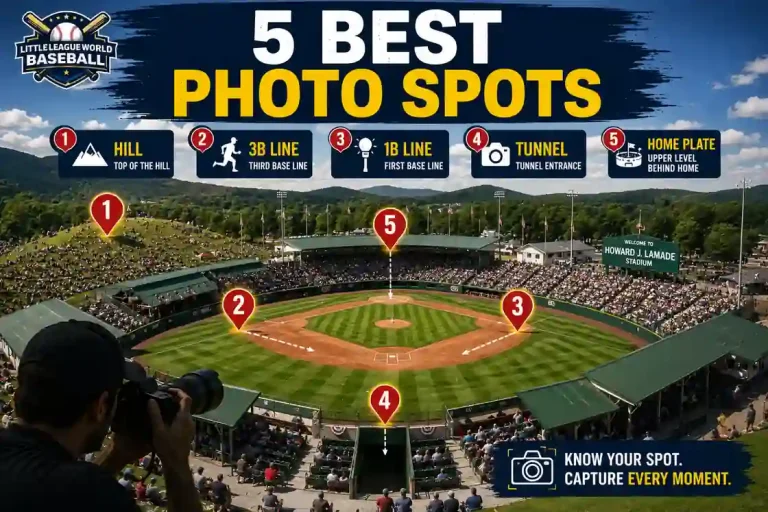
Spot 1: Top of the Hill – Wide Stadium Panoramas
The grass berm beyond the outfield fence rises steeply to a ridge that sits well above the playing surface. From the top of the hill, you can see the entire field, both dugouts, the packed grandstand, and the mountain ridge above the stadium. This is the most unique shot in all of LLWS photography and the one ESPN uses for their wide establishing shots.
Spot 2: Third Base Line – Morning Game Action
For morning and early afternoon games (1:00 PM and 2:00 PM ET), the third base side puts the sun at your back. This is the most fundamental rule of sports photography – shoot with the sun behind you so your subjects are well lit. The third base line gives you direct sightlines to the pitcher’s delivery, the batter’s swing, and the first and second base paths.
Spot 3: First Base Line – Evening Stadium Lights
For evening games, the first base side catches the stadium lights at their best angle. Lamade Stadium’s lighting system was upgraded with a Musco Sports Lighting installation in 2022. The lights are excellent for photography, with consistent color temperature and minimal harsh shadows. Evening games under lights at Lamade are some of the most atmospheric shots at the LLWS.
Spot 4: Tunnel Entrance Level – Low Angle Action
The stadium concourse tunnels that connect the seating to the field level create natural low-angle shooting positions. Standing at the tunnel mouth puts you at near field level, the same perspective ESPN’s dugout cameras use. You can still stand upright while shooting significantly lower than the grandstand level. This is the position professional photographers use most during LLWS games.
Spot 5: Behind Home Plate Upper Level – Full Field View
The upper rows behind home plate give a broadcast-camera perspective of the entire field. You can see the pitcher, batter, all fielders, and the outfield hill simultaneously. This position is best for capturing the scale of the event – the small players on the big field with 40,000 fans packed behind them.
Best Photography Spots at Little League Volunteer Stadium
Volunteer Stadium hosts international bracket games and opening ceremonies. It is smaller and less crowded than Lamade, which actually creates better photography conditions for most fans. You can get closer to the action, access better angles, and move more freely between positions.
Spot 1: Outfield Berm – Intimate International Team Shots
The berms surrounding Volunteer Stadium are smaller than Lamade’s hill but give excellent sightlines around the outfield perimeter. Fans line the entire outfield fence at Volunteer Stadium during popular international games. The flags from 20 countries are more visible from the Volunteer Stadium side of the complex.
Spot 2: Opening Ceremonies Position – Volunteer Stadium Infield
Opening Ceremonies take place at Volunteer Stadium on August 19 at 11:00 AM ET. All 20 teams parade across the field in their uniforms. This is the single best opportunity for international team photography at the entire tournament. Every team is in frame, flags are flying, and the energy in the stadium is at its peak before a single pitch is thrown.
Best Photo Opportunities Outside the Stadiums
Some of the best LLWS photos do not happen inside either stadium. The Little League International Complex has several locations that produce photographs you cannot get anywhere else.
| Location | Best Shot | Best Time |
|---|---|---|
| International Flags at Museum Entrance | All 20 country flags against the sky – one of the most iconic LLWS images | Morning light before 10:00 AM – flags are crisp, and the sky is blue |
| Giant Live Bracket Display | Tournament bracket updating after each game – fans checking results | Immediately after games end |
| Team Walk from Housing to Stadiums | Players in uniform walking through the complex – candid, natural shots | 30 to 45 minutes before each game |
| World of Little League Museum | Museum exterior with LLWS signage – classic arrival shot | Morning before crowds arrive |
| Fan Zone Sponsor Activations | Kids and families at interactive sponsor booths – lifestyle photography | Midday between games |
| Cardboard Hill Sledding | Kids sliding down the Lamade hill on cardboard – pure joy shots | Between innings during afternoon games |
| Post-game Team Celebrations | Player celebrations on field after wins – the most emotional shots | Final out of each game |
The cardboard hill tradition: Between innings during Lamade Stadium games, kids slide down the upper grass hill on pieces of cardboard. This has been a LLWS tradition for decades. The images of children sliding with the packed stadium and mountain in the background are among the most uniquely LLWS photographs you can take. Position yourself mid-hill looking upward to catch sliders coming toward you.
Understanding Light at the LLWS – When to Shoot What
August light in Williamsport follows a predictable pattern. Understanding it lets you plan which shots to prioritize at which time of day. Good light makes the difference between a snapshot and a photograph worth keeping.
| Time of Day | Light Quality | Best For | Avoid |
|---|---|---|---|
| 6:00 AM to 8:00 AM | Soft, golden, low angle – ideal portrait light | Complex exterior shots, flags, stadium architecture, arriving teams | Action shots – no games yet |
| 9:00 AM to 11:00 AM | Bright, clean, slight warmth – excellent for games | Opening ceremonies, early warm-ups, team portraits | Direct sky backgrounds – too bright |
| 11:00 AM to 1:00 PM | Overhead midday sun – harsh shadows under eyes and brims | Wide field shots, crowd shots, bracket displays | Close-up portraits – shadows are unflattering |
| 1:00 PM to 4:00 PM | Bright, high sun – hot but manageable with correct position | Game action with sun at your back from third base side | Shooting into the sun from first base – bleached backgrounds |
| 4:00 PM to 6:30 PM | Golden hour approaching – warm, directional light | Player portraits, dugout shots, hill panoramas with warm sky | Fast action without enough shutter speed |
| 6:30 PM to 8:00 PM | Mixed natural and stadium light – dramatic transition | Stadium atmosphere shots, field under lights beginning | Auto mode – switch to manual or sports mode |
| 8:00 PM onward | Full stadium lights – consistent but requires higher ISO | Night game action, dugout reactions, stadium ambiance | Low ISO settings – photos will be blurry |
Camera and Phone Settings for LLWS Photography
For DSLR and Mirrorless Camera Users
| Situation | Shutter Speed | Aperture | ISO | Mode |
|---|---|---|---|---|
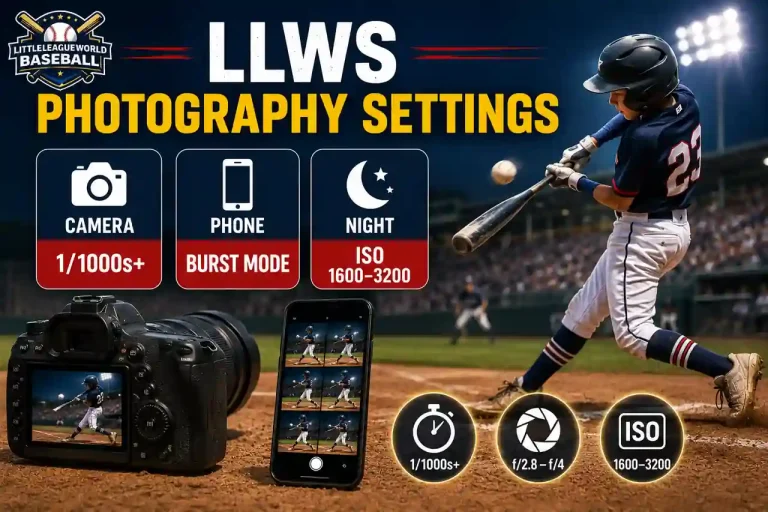
| Daytime game action | 1/1000s or faster | f/4 to f/5.6 | 400 to 800 | Shutter Priority or Manual |
| Evening game action | 1/500s minimum | f/2.8 to f/4 | 1600 to 3200 | Manual or Auto ISO with shutter priority |
| Portrait – players pregame | 1/250s | f/2.8 to f/4 | 200 to 400 | Aperture Priority |
| Wide stadium shots | 1/250s | f/8 to f/11 | 200 to 400 | Aperture Priority |
| Golden hour hill shots | 1/500s | f/4 to f/5.6 | 400 to 800 | Manual |
Continuous autofocus (AI Servo on Canon, AF-C on Sony and Nikon): Baseball action is unpredictable. A pitcher’s release, a batter’s swing, and a fielder’s dive all happen in under a second. Continuous autofocus tracks moving subjects as they move. Set it before the first pitch and leave it on.
For Smartphone Photographers
| Situation | Setting | Tips |
|---|---|---|
| Daytime action | Sports mode or Burst mode | Hold shutter button to fire continuous burst – pick the sharpest frame afterward |
| Wide stadium shots | 0.5x ultra-wide | Use during lineup shots and hill panoramas – captures full scale of the venue |
| Player close-ups | 2x or 3x telephoto | Do not use digital zoom beyond your phone’s optical zoom – images lose sharpness |
| Evening games | Switch to Night mode manually | Do not wait for automatic switch – activate it as the sun sets |
| Portraits | Portrait mode at 1x | Best results within 6 to 8 feet of your subject |
| Celebrations and emotions | Video then screenshot OR burst mode | Celebrations are fast – video captures everything, pull stills from the best frames |
What Camera Gear to Bring to the LLWS
Remember the clear bag policy; everything must fit in a bag no larger than 20 x 20 x 6 inches. Professional camera equipment is not permitted without a media credential. Plan your kit accordingly.
| Gear | Recommended | Notes |
|---|---|---|
| Smartphone | Fully permitted | Best all-around choice for most fans. Modern smartphone cameras handle sports photography well in good light. |
| Point and shoot camera | Permitted | Compact cameras without detachable lenses are generally allowed. Check Little League’s current equipment policy before arriving. |
| DSLR or mirrorless camera | Media credential required | Professional camera bodies with interchangeable lenses require a media credential from Little League International. |
| Long telephoto lens (300mm+) | Media credential required | Long lenses are professional equipment. Not permitted without credentials. |
| Monopod or tripod | Not permitted | Poles and sticks are on the prohibited items list. No tripods or monopods allowed. |
| Selfie stick | Prohibited | Explicitly on the prohibited items list. |
| Extra batteries and memory cards | Permitted | Bring extras – a full day of sports photography drains batteries quickly. |
| Portable charger | Permitted | Essential for smartphone photographers spending a full day at the complex. |
Photography Credentials at the LLWS – What You Need to Know
Little League International issues four levels of media credentials for photographers. If you are covering the LLWS as a working photographer for a publication, website, or media outlet, you need to apply through Little League’s media relations team in advance.
Video streaming is prohibited: Live streaming of game footage in any format is strictly prohibited at the LLWS and considered copyright infringement under federal and state law. ESPN holds exclusive global broadcast rights through 2030. This applies to all fans and credentialed media alike. Still photography for personal use is fully permitted.
The Best LLWS Photos Are Not Always of the Action
The most memorable photographs from any LLWS come from the moments between the plays. A dugout reaction after a big strikeout. A parent in the stands covering their face.
A coach and player sharing a word on the mound. A team celebrating in a pile at the pitcher’s mound. These images tell the story of the tournament better than any perfectly sharp action shot.
| Shot Type | Where to Position | When to Look |
|---|---|---|
| Dugout reactions | Tunnel level near dugout entrance | After big strikeouts, home runs, and double plays |
| Parent reactions in stands | Family seating sections – ask where home team families sit | After dramatic plays – watch for authentic emotion |
| Post-win celebration pile | Position by the winning team’s dugout in the final inning | Final out – move quickly, celebrations are brief before teams line up |
| Mound visit moments | Third base side, as close to field as permitted | Any pitching change or coach visit – these conversations are gold |
| Between-inning water break | Near dugout steps | Players coming off the field – candid moments at age 12 are authentic and beautiful |
| National anthem – players lined up | Behind the first base line looking down the line toward the flag | Anthem begins – players remove hats and face the flag together |
| Loss and tears | Losing team dugout – approach with respect and distance | After elimination games – never intrude on private grief moments |
Respect the players: These are 12-year-old children. When photographing emotional moments, especially after losses, maintain respectful distance. Do not push into tight spaces around players or their families. The best emotional photographs are taken with a long lens from a respectful distance, not by crowding a child during a vulnerable moment.
Conclusion
The LLWS complex offers some of the most unique photography opportunities in American sports. Howard J. Lamade Stadium‘s grass berm, mountain backdrop, and 40,000-person capacity create images no other youth sports venue can match. Shoot from the top of the hill for panoramas.
Work the third base line in morning games. Get low at tunnel level for field-level action. Let the evening light work for you at 7:00 PM games. And remember the most powerful photographs at the LLWS are almost always of the faces, not the plays. The 2026 LLWS runs August 19 to 30 in South Williamsport, Pennsylvania.